The Loco: Chile’s Most Controversial Delicacy
4 de mayo de 2014
When and How Did Salmon Arrive in Chile?
6 de mayo de 2014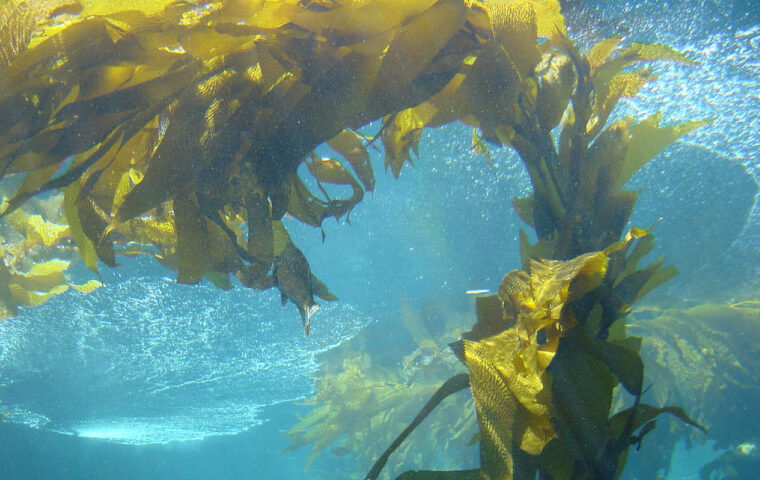
When we talk about fisheries in our country, the first thing that comes to mind are regularly caught species such as hake, anchovy, or horse mackerel. However, there is one fishing market that is largely unknown: macroalgae; all those algae that can be seen without a microscope and are found at depths of up to 30 or 40 meters.
Below, we share some information about macroalgae in Chile.
Brown algae are so named because they contain a photosynthetic pigment known as fucoxanthin, which gives the plant its color and allows it to photosynthesize at greater depths than green algae. These species form in large communities on cold-water rocky coasts called «kelp forests» or «huirales,» which host, provide food, and habitat for a wide variety of marine species.
In Chile, there are six representative species of brown macroalgae: black huiro (Lessonia berteroana, Lessonia spicata, Lessonia flavicans, Lessonia searlesiana), stick huiro (Lessonia trabeculata), and floating huiro (Macrocystis pyrifera). Black huiro is distributed throughout the country, while stick huiro can be found from Arica to Chiloé. Floating huiro is found from Arica to Cape Horn. All of them play an essential role in the development of marine ecosystems, as they have been described as some of the most diverse and ecologically dynamic habitats.
Brown macroalgae allow the colonization of other marine algae and invertebrates such as sea urchins, limpets, and snails. The presence of these organisms attracts other predatory species such as the sea snail, starfish, and the dogfish. Moving up the food chain, we find mammals such as the common sea lion and the chungungo, which feed on species associated with brown macroalgae forests. Furthermore, macroalgae provide refuge from predation and bottom currents, are settlement areas for some fish, and are where fish spawn (egg-laying) and rear.
Furthermore, brown macroalgae forests protect the coast in the event of extreme weather events such as storm surges, tsunamis, and cyclones. They also buffer coastal erosion.
Initially, seaweed harvesting in Chile involved harvesting species that naturally reached the shores. However, given the increasing commercial value of these species, a practice known as «barreteo» was introduced: a technique in which the entire living seaweed is removed from the rock, preventing its regrowth.
Thus, the market for brown macroalgae has begun to grow in our country. Black huiro and palo, for example, are dried and chopped before being exported and used in the production of products such as alginic acid, a substance that helps preserve food. Floating huiro is used as feed for abalone farming and other byproducts.
The most extracted species in Chile is black huiro. In 2002, 100 tons of this species were extracted annually, a figure that increased exponentially in 2013, exceeding 300 tons. A similar phenomenon was seen in the two major species of brown macroalgae, although in smaller quantities. The sector of the country where these algae are extracted the most is in the north, specifically the first four regions, while the main international markets are China, Japan, Norway, and France, where the use of algae is closely linked to the food and cosmetics industries.
Currently, unfortunately, the extraction of this resource in Chile lacks more effective regulation and oversight, leading to high levels of illegal fishing and, consequently, the deforestation of these habitats crucial to marine life. As a result, many of the fisheries that sustain the country and the lives of hundreds of people are under threat.
Brown macroalgae form forests, blue forests, where marine life thrives, which help regulate global warming and provide oxygen to the planet. If their existence is endangered, the existence of the environment as a whole is endangered.